Guide
How to test a churn model before you use its scores
A customer success team has time for fourteen calls. A model has flagged fourteen account reviews. Before handing over the list, find out how often that same rule would have picked an account that actually left.
Give every score a decision date
In Fieldwork, a synthetic SaaS business, one row represents one account on a monthly review date. The question is whether the account will churn the following month. Active seats and overdue days are visible at review time. A later cancellation email would give the model information the team wouldn’t have when it makes the call.
Leave the outcome blank on the newest rows until the following month has passed. An empty answer means you’re still waiting to find out. Entering “no” would teach the model that those customers stayed.
Test on the next stretch of history
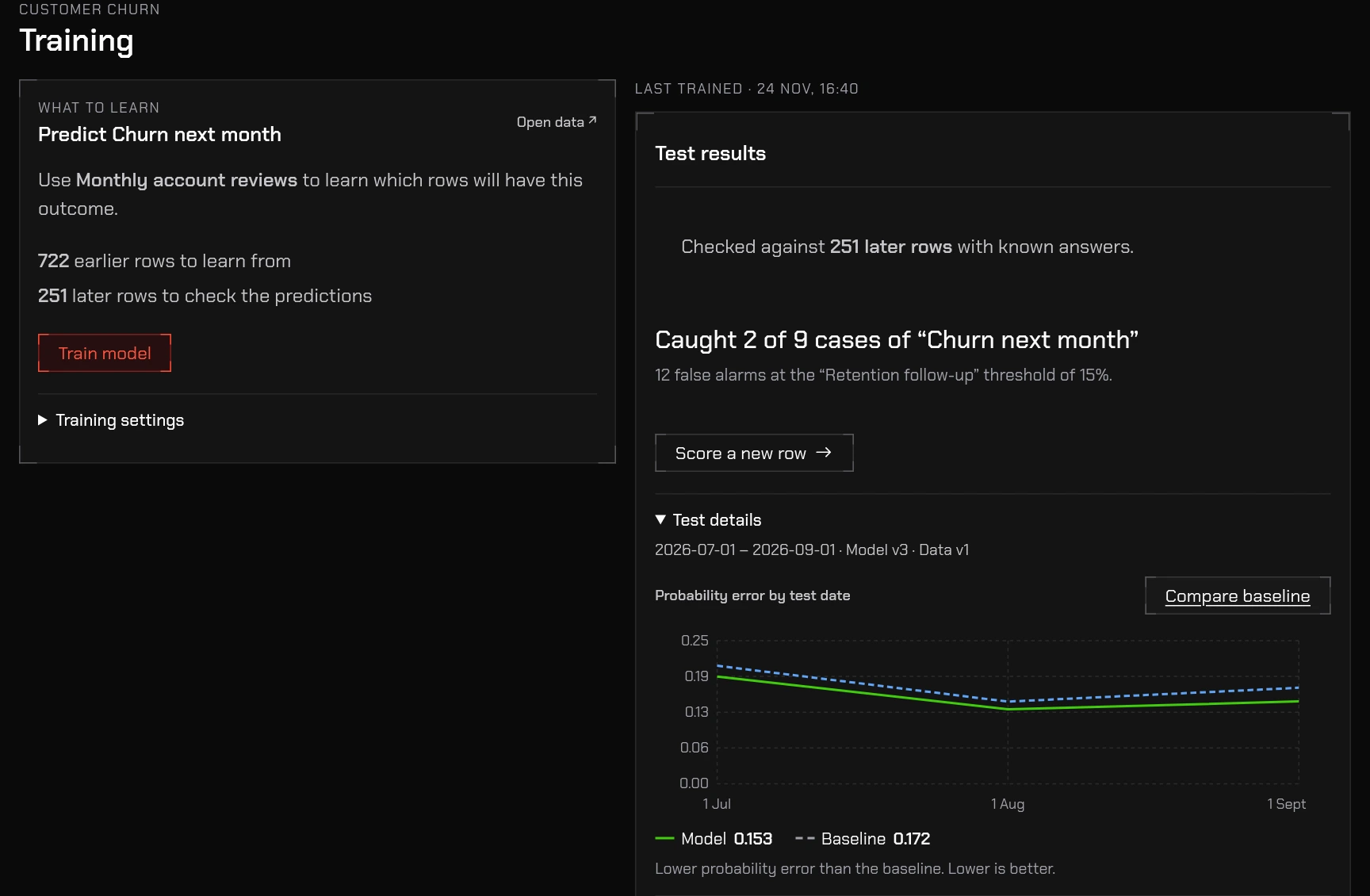
Fieldwork’s model learned from 722 earlier reviews. The next 251 reviews, all with known answers, were reserved for the test. Keep reviews from the same date together. If a label takes a month to arrive, also check which answers would have been available on the day you imagine training the model.
Count the calls you’d actually make
At a 15% score cutoff, the model flagged 14 of the 251 held-out reviews. Two were followed by churn and 12 were false alarms. Nine reviews in total were followed by churn, so seven slipped through.
The first fraction, precision, tells the team what to expect when it opens the list. The second, recall, tells it how much churn it misses. Compare those counts with your existing outreach rule on the same rows and at the same call budget. If you change the cutoff after seeing the answers, reserve another period for a fresh check.
These counts come from synthetic data. In a real retention program, measuring whether the calls themselves prevent churn takes a separate comparison between customers who receive outreach and comparable customers who don’t.